

Tire sizing explained
What does the “C” mean? (Or the “B”?)

Feedback on mating tire and rim widths:
Dear Lennard,
My experience is in Australia with poor surface roads. I try and advise to keep the internal width of the rim to be 80% of the tyre width size with a 70-90% range. So a 700 x 32 tyre on a 26 mm IW rim. So for a 32 mm tyre, [I advise] from 22 mm to 29 mm internal width rim, with 26 being optimal.
The only reason anyone would use a smaller tyres/rims is to reduce weight for acceleration and/or hill climbing, criterium racing.
Dan
Dear Lennard,
I am a tandem captain who works on his own bike. With a combined weight of about 380 pounds, we will likely continue using inner tubes and hooked rims for the rest of our riding career. The thought of dealing with sealant is much scarier that dealing with patching tubes or carrying spares.
But I want to make sure we are using the right combination of tires and rims. We are moving toward larger tires (28mm to 32mm to 35mm as our frame will allow), but rims are more expensive to change than tires, particularly those with 40 or 48 spokes.
The post of Dec 29 made me think of this issue in more depth. It also confused me since 72% is also 0.72, until I went back and looked at the December 16 post combo chart that you prepared.
The charts on your December 16 post, (which I finally looked at closely) show dimensions as 13C, 14C, etc. The Schwalbe chart labels these as mm, but the Mavic chart doesn’t. Neither notes the significance of the “C”. I also notice you took the “C” out of your combined chart.
Can a hooked rim simply be measured as the width between the faces of the hooks, or is this some sort of nominal measurement?
Many posts ago, you posted or referenced a cross section of various rims showing the dimensions, but I couldn’t find it. Could you repeat or lead me to it?
I hate to cloud or belabor the issue, but, as you note, the bicycle tire world is like the wild west compared to automobiles.
Richard
Dear Richard,
Yes, hooked rim internal width is measured between the faces of the hooks. It is nominal; it increases under tire inflation pressure, and, as Evan from WTB mentioned two weeks ago, it can also change under rim-brake forces and spoke tension.
I don’t know which cross-section illustration you mean. Maybe this one showing BSD and inner rim width from Zinn and the Art of Road Bike Maintenance?
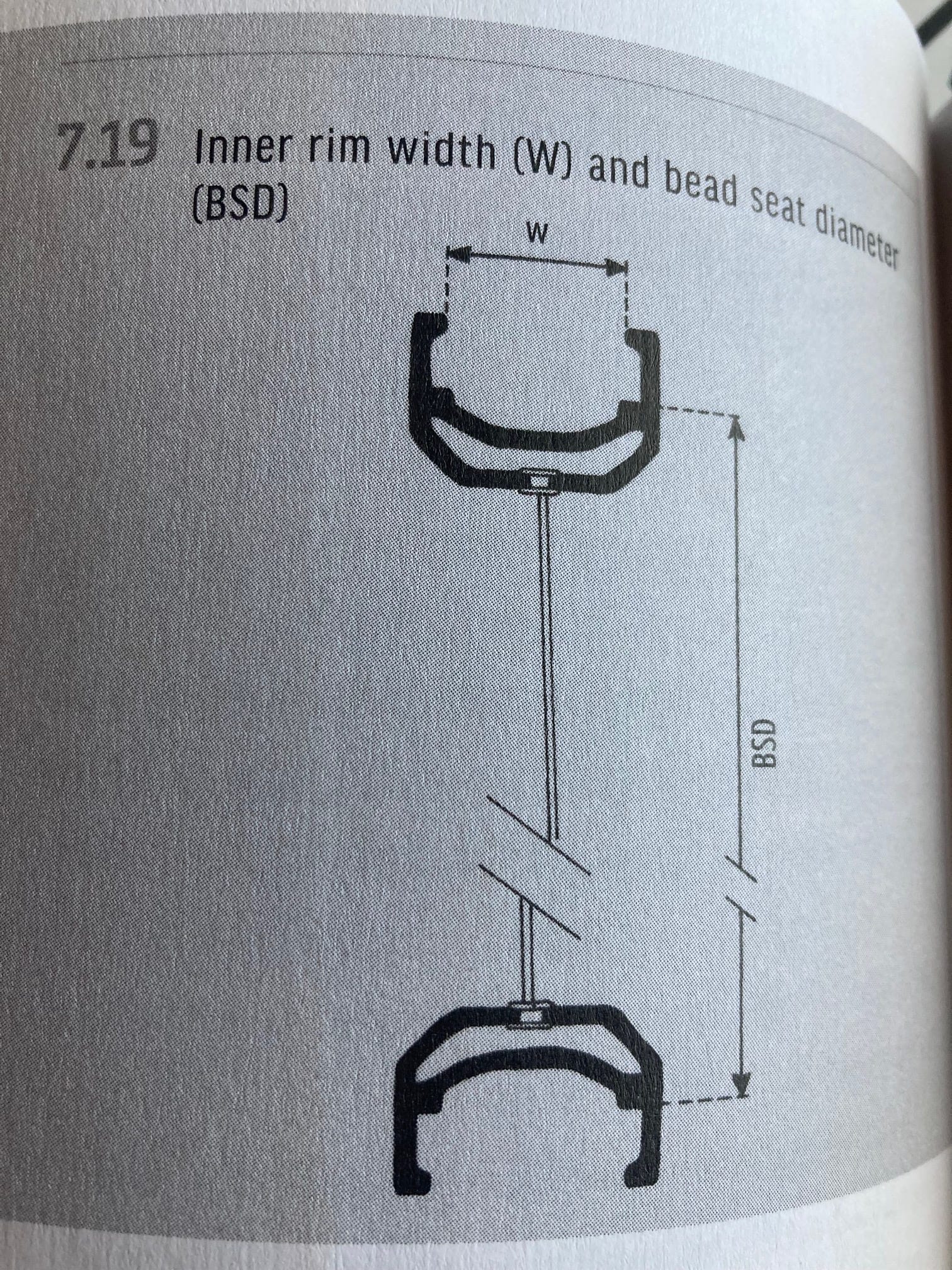
As for your question about the letter designations on the chart, “C” is a nominal width on tire labels that doesn’t guarantee a specific inflated width. I have gotten so many questions over the years about what the “C” means in “700C” or “700 X 28C” that I’m going to explain it here.
There is no “C” size standard referring to rim width, so I took out the “C” next to the rim widths on the Mavic chart when I made the combined chart because it was confusing. The “C” that had been in there likely referred to the rim type (either “clincher” or “crotchet”) rather than to the dimensions that the rim width that it followed were measured in.
The “C” on a tire size label
In bicycle tire sizes, the first number in the traditional French labeling tradition is the nominal tire diameter in millimeters, the second number is the nominal tire width in millimeters, and the letter is used to designate the width of the rim and the tire and the rim diameter. It now only designates the rim diameter.
Tires today not only carry the traditional French style of size labeling (like 700 X 25C) but also carry their more precise ETRTO (European Tire and Rim Technical Organization) designation. The ETRTO specifies tire size in an XX-XXX format with only two numbers and no letters. The first number (XX) is the nominal tire width in millimeters, and the second number (XXX) is the Bead Seat Diameter (BSD): the internal diameter of the rim that the tire bead sits on (see above illustration). 700 X 25C in ETRTO parlance is 25-622.
Furthermore, “nominal tire width” is the tire’s width when inflated on a specified design rim that Evan from WTB described using the below chart of design rim widths for tire widths. The actual tire width changes slightly, by around ±0.4mm per 1mm change in rim width, when mounted on rims with different internal widths.
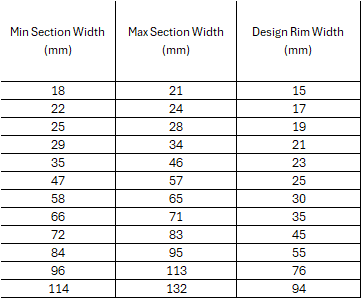
Even though that combined Mavic/Schwalbe chart I made showed tire widths in millimeters, those are nominal widths dependent on rim width and other factors. “Nominal” allows a range; I recall that for most bike tire widths, the allowable range in the ETRTO standards is ±4mm. In other words, it is allowable to label a tire as “700 X 28C” if its inflated width is anywhere between 24mm and 32mm; this accounts for different measured widths on different rim widths.
Contrary to popular belief, the “C” on tire size never referred to “centimeters” or even to “clincher” (or “crotchet” or “crochet”); it was always an arbitrary designation as part of a letter series. Originally, the A, B, C, D designations in the old French sizing system referred to the tire width and rim width and diameter, A being the narrowest rim/tire and D being the widest. Now those letters refer only to the Bead Seat Diameter (BSD).
In the case of 700C tires, the “C” would have denoted a medium-width tire in the old French system (around 38-40mm historically) with a 700mm nominal outer diameter. 700C now refers to any tire, from very narrow to very wide, that fits on a rim with a 622mm BSD.
In the old French sizing system, since the first number was a nominal tire diameter and the letter was a nominal tire width, the letter sizes of fatter tires with the same first number resulted in smaller rim diameters so that they would have the same nominal outside tire diameter, and vice versa. For example, 700A (narrow) tires fit on rims with a 642mm BSD, 700B (medium narrow) tires fit on 635mm BSD rims, 700C (medium wide) tires beget 622mm BSD rims, and 700D (wide) tires have 583mm BSD. There’s no need to remember 700A, 700B, or 700D, since they have been abandoned.
In contrast, in “650” sizes, only the 650B (584m BSD) designation remains on tire labels. 650A (590mm BSD) and 650C (571mm BSD) tire sizes still exist but are not printed on the tire labels; tires for those rim sizes are instead labeled in inch designations (26 X 1-3/8” and 26 X 1”, respectively; yes, tire widths labeled in fractions fit different rim diameters than those labeled with decimal widths despite both being marked as 26”, 24”, etc.).
We also now have 750D (660mm BSD), a larger size between 700C and 32” that was introduced by WTB in 2023. In the old French tradition, the “D” would have indicated a wide (~45mm) tire; however, WTB only offers 750x34D and 750x42D. My guess is that WTB added the “D” for symmetry with letter size designations remaining in use in the smaller sizes below it, since 750D sounds like a natural progression coming after 600A, 650B, and 700C.
Sheldon Brown has complete charts of tire sizing here. You won’t find 750D on them, as that size didn’t exist until 15 years after his death.
Subscribers can send brief technical questions to Lennard at: veloqna@comcast.net.
Lennard Zinn has been designing and building custom bicycles for over 45 years; he founded Zinn Cycles in 1982 and co-founded Clydesdale Bicycles in 2017. His Tech Q&A column on Substack follows his 35-year stint as a technical writer for VeloNews (from 1987 through 2022). He is a former U.S. National Cycling Team member and author of many bicycle books including Zinn and the Art of Mountain Bike Maintenance, Zinn and the Art of Road Bike Maintenance, and The Haywire Heart. He holds a bachelor’s degree in physics from Colorado College.
Follow Lennard Zinn on Substack, Strava, X, Instagram, LinkedIn, or Facebook.
We used to have an employee at our shop who had memorized the history of tire and tube sizing. If we had a customer we needed to move along, we would tell our employee that said customer had requested an explanation of tire sizes. That usually did it.