

PVCs
Are skipped or premature heart beats harmless?

Come ride the Enchanted Circle Century with me this Saturday, August 8. I’ll also be doing a shakedown ride and a clinic the prior afternoon at our booth at the expo in Red River, where I’ll also be available to speak with about bikes, bike fitting, and athlete hearts after the ride on Saturday.
Dear Lennard,
As a long-distance cyclist, I’ve previously been diagnosed with PVCs after my iPhone flagged them and a cardiologist confirmed it. It’s been a while since I felt one, but this article raised a question: short of an AFib alert on my phone, what symptoms or signs should I be keeping an eye on? I do try to effectively manage water and electrolytes.
Carbonstories
Dear Carbonstories,
PVCs themselves are considered benign. However, they can trigger AFib and other arrhythmias or can become so frequent that they disrupt blood flow, so yours is an important question to ask.
PVCs (Premature Ventricular Complexes or Premature Ventricular Contractions) and PACs (Premature Atrial Complexes or Premature Atrial Contractions) generally are more likely to happen at rest. They feel like a skipped beat. Since the person experiencing them is unlikely to feel the difference between them, I will discuss both. PVCs and PACs are side effects of one of the heart’s fail-safe systems that can keep it beating even when its normal system to initiate beats ceases to function properly.
Pacemaking
The heart is the only muscle in the body that requires no signal from the brain to contract. Normally, the natural pacemaker of the heart is the sinus node (a.k.a. sinoatrial, or “SA” node) in the upper corner of the back wall of the right atrium, near where the superior vena cava (which delivers deoxygenated blood into the right atrium from the upper body) enters.
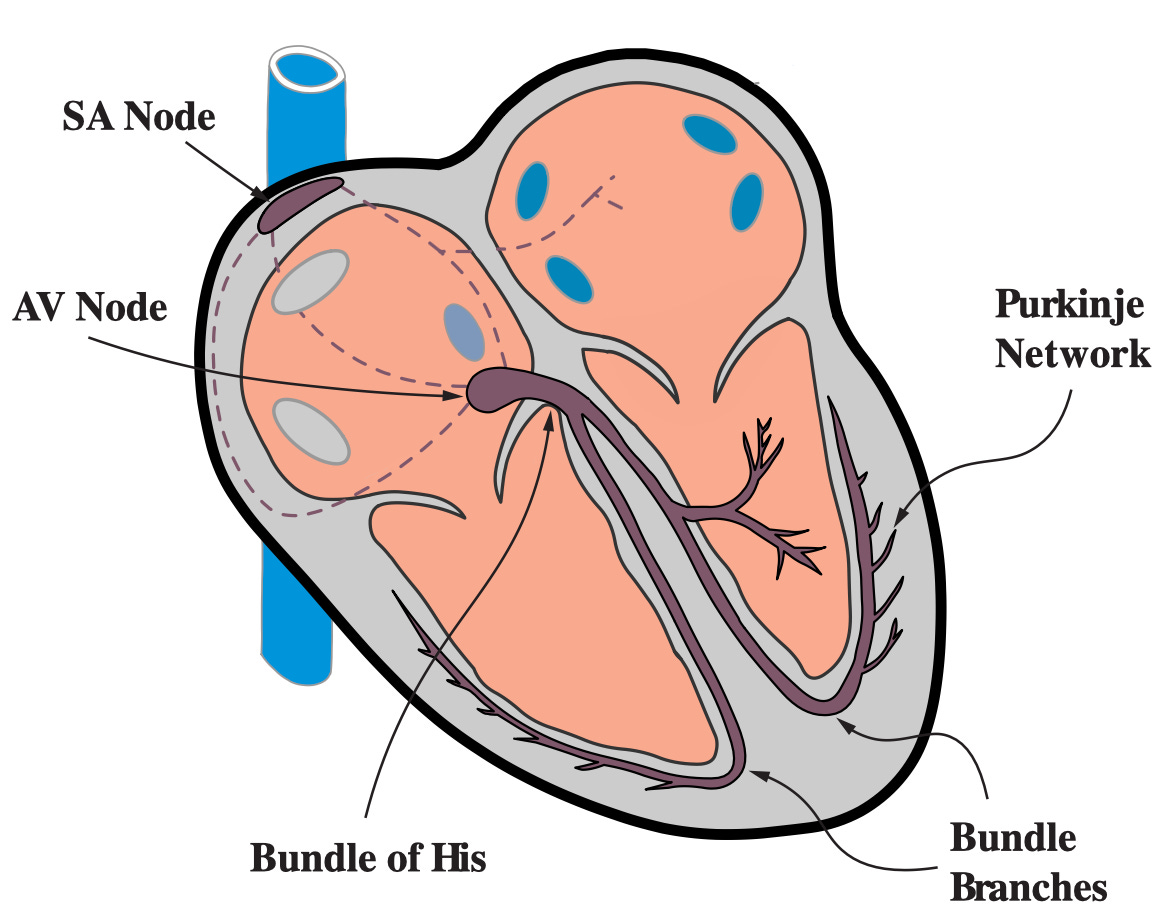
Based on signals from the autonomic nervous system, the SA node determines the heart rate. When calming signals come from the parasympathetic nervous system via the vagus nerve, the SA node sets a slow heart rate. When the body is in fight-or-flight mode, the sympathetic nervous system activates and releases stress hormones like adrenaline, norepinephrine and epinephrine, which bind to beta receptors on the SA node, causing it to “depolarize” (i.e., fire its electrical signal) more frequently, thus setting a fast heart rate.
The fail-safe mechanism I mentioned is that any cardiac muscle cell can develop “enhanced automaticity” and become a pacemaker cell. Since cardiac cells are connected by pores in their cell walls called “gap junctions” through which charged particles (ions) can pass from one cell to another, a string of them is akin to a wire conducting electricity. If one of them depolarizes, the rest of them down the string depolarize as well, causing the muscle to contract.
The signal for a cell to depolarize is the voltage at its cell wall (cell membrane). Cells create electrical potential energy, or voltage, by polarization, namely by concentrating positive charge in one area and negative charge in another. Depolarization is the reverse of this.
The spatial separation of oppositely-charged ions inside and outside the cell creates a “membrane voltage” or “membrane potential”. The cell membrane is impermeable to ions except through ion channels. Voltage-gated ion channels are ion channels that only allow one-way movement of a certain type of ion through the membrane, and cardiac cells have them specific to sodium (Na+), potassium (K+), calcium (Ca2+), and chloride (Cl–) ions.
A cardiac muscle cell maintains a resting membrane potential of about –90 mV (millivolts) by continuously running its sodium-potassium pump, which pushes three sodium (Na+) ions out of the cell for each two potassium (K+) ions it pulls into the cell, costing it energy and using up adenosine triphosphate (ATP) in the process. Continuously exchanging three Na+cations (out) for two K+ cations (in) not only makes the inside of the cell more negative, but it also maintains the concentration of sodium high outside of the cell and low inside, while the opposite condition holds with potassium. In other words, the cell creates both voltage and concentration gradients inside and outside its membrane, making it ripe for depolarization to neutralize those gradients.
Pacemaker cells don’t maintain a contraction. Instead of having a stable resting membrane voltage like other cardiac cells, a pacemaker cell’s membrane potential during diastole (when the heart is relaxed) is unstable. The cell gradually depolarizes by allowing sodium ions (primarily) to enter through leak channels until it reaches a threshold membrane voltage (the “pacemaker potential”) of around –40 mV, at which point the cell spontaneously depolarizes.
Since it takes a while to reach that pacemaker potential, spontaneous depolarization in most of the heart’s pacemaker cells happens on a time scale that is slower than the frequency at which signals arrive from the SA node, so the SA node generally dictates the heart rate. Spontaneous depolarization happens faster in the SA node than in other pacemaker cells, typically 60 to 100 times per minute, so it tends to precede others in generating electrical impulses.
With conditioning, however, the heart can enlarge and pump more blood volume per beat, and the body can use oxygen more efficiently. Recognizing that blood flow is sufficient at a lower heart rate when at rest, the parasympathetic nervous system sends signals to the SA node to reduce the rate. Resting heart rate in some athletes can drop below 30 beats per minute. If the resting rate drops below the rate of spontaneous depolarization of some pacemaker cells, those pacemaker cells can depolarize before a signal to do so comes from the SA node, and the pacemaker cells will initiate premature heartbeats.
Skipped beats
Perhaps you’ve had the experience, while resting quietly, of your heart feeling like it stopped momentarily—it skipped a beat or two. In fact, it didn’t miss a beat but instead contracted prematurely (“premature complexes”). It felt like a skipped beat because the heart chamber contracted out of phase and didn’t push enough blood for you to feel the beat. Because the contraction came early, the chamber had not had the chance to fill completely with blood before it contracted, and little or no blood flow resulted.
A pause generally follows when the out-of-phase contraction hits the SA node, because the contraction resets the node to its underlying rate. The SA node then waits its normal period between contractions before initiating a new heartbeat.
For simplicity of calculation, say your resting heart rate is 30 bpm, which means there are two seconds between beats. That long wait period between beats can allow the membrane potential of rogue pacemaker cells to reach their pacemaker potential and initiate a premature, out-of-phase beat that propagates through your heart. Since your vagus nerve is signaling that you are at rest, your SA node will continue to pace your heart at its normal 30 beats per minute. Since the premature beat reset the SA node as if an actual beat had happened, the node now waits the normal two seconds between beats to initiate the next one. This means that there will be around four seconds between beats you can feel, and if another PAC or PVC slips in there before that next pacing signal from the SA node, that period between beats can be longer yet. That’s why it can feel like your heart stopped momentarily. When I was wearing a Holter monitor that takes a continuously-monitored ECG a few months after my initial arrhythmia diagnosis, I got a phone call from somebody remotely monitoring it to alert me that I had had an eight-second pause between heart beats. This can explain that.
Premature contractions in the atria are PACs, and premature contractions in the ventricles are PVCs. Both can be caused by healthy pacemaker cells, but they are more often created by clusters of cells that have somehow gained “enhanced automaticity” and are behaving like pacemaker cells. PVCs can happen frequently in some elite masters athletes—on the order of 25,000 PVCs per day! That’s about a quarter of the number of daily beats and is so disruptive that blood flow is significantly reduced. Treatment or a great reduction in athletic workload is mandated.
Premature beats setting off arrhythmia
In my case, I used to feel PVCs or PACs often while at rest. I have practiced Transcendental Meditation daily for 50 years, and when I was fit and racing successfully, I felt lots of them during every period of meditation. However, that changed so that they also occurred while exercising, and my arrhythmia first appeared right after one. I was going hard up a long, half-hour climb on which I had the 55+ Strava KOM in an attempt to cut minutes off that time. About halfway up, I suddenly felt a PVC or PAC. I took notice because I had never felt one while going hard at an elevated heart rate.
I looked down at my Garmin and saw that my heart rate had suddenly jumped after that premature beat from the mid-150s to 218 bpm where it stayed for the next seven minutes until I stopped and gave up on my KOM attempt.
Atrial fibrillation triggered by premature beats
A PVC can sometimes trigger an episode of AFib if the electrical impulse from a PVC travels upward from the lower chambers (ventricles) through the heart’s electrical pathways into the upper chambers (atria). This “retrograde conduction” can set off the chaotic rhythm of AFib. Research has shown that a high daily PVC count increases long-term risk of developing new-onset AFib.
Through a different pathway, a PAC can also trigger an episode of AFib, particularly when PACs are frequent or originate in particular areas. A PAC during diastole, the heart’s recovery cycle, can spark AFib, especially if the PAC started near the pulmonary veins (where Afib often initiates).
As I explained with the goat studies two weeks ago, diseased atria are required for AFib to be sustained. Having a high number of PACs each day, however, raises the risk of developing persistent AFib because frequent premature beats can lead to structural changes (i.e., disease) in the atria—the fibrosis (i.e., scar tissue), dilation, stretch, and inflammation that I mentioned a couple of weeks ago. Rather than always being harmless, frequent PACs often point to an irritable or stressed atria, the substrate for AFib to occur and be sustained.
It’s good you take care with hydration and electrolytes. Stress, caffeine, electrolyte imbalances, and lack of sleep can increase the likelihood of both PVCs and AFib. If you notice PVCs happening in the thousands per day or while exercising, take those concerns to a cardiologist.
― Lennard
Subscribers can send brief technical questions to Lennard at: veloqna@comcast.net.
Lennard Zinn has been designing and building custom bicycles for over 45 years; he founded Zinn Cycles in 1982 and co-founded Clydesdale Bicycles in 2017 and Tui Bikes in 2022. His Tech Q&A column on Substack follows his 33-year stint as a technical writer for VeloNews (from 1989 through 2022). He is a former U.S. National Cycling Team member and author of many bicycle books including Zinn and the Art of Mountain Bike Maintenance, Zinn and the Art of Road Bike Maintenance, and The Haywire Heart. He holds a bachelor’s degree in physics from Colorado College.
Follow Lennard Zinn on Substack, Strava, X, Instagram, LinkedIn, or Facebook.
Been bicycling again for three years, age now 77. I bought a Kardia-6 a few weeks ago, been using it to get an idea of what my heart's doing on a daily basis. Yesterday I enjoyed a 32 mile ride, some of the route on roads new to me, that took 2 hours 20 minutes to complete. Longest (ever) ride was a few weeks back, 38 miles. I think I'm probably in the best physical shape I've ever been in at this point.
After I'd been home from yesterday's ride for maybe ten minutes I grabbed my Kardia, took an ECG. First time I've seen a PVC noted in the five weeks I've been tracking ECG's twice a day. That label caught my attention so I immediately ran another ECG that came back normal.
I've read that PVC's can be precipitated during recovery so I'm taking note of the first time appearance and the timing. Kardia's also telling me pretty often that Bradycardia's evident from the under 50 HR numbers I can claim upon waking then testing each morning. Low HR seems to follow closely on my biking activities but as the only tell I've received is from the Kardia device I'm simply taking it as a result of the improved cardiac function my biking's brought to my body.
For years I had occasional PVCs on my checkups and they were ruled benign. Three years ago I noticed the frequency had increased and it felt like someone was poking me in the chest. My HR monitor started showing weird spikes even when I was resting and I thought it was defective. Asked my cardiologist if it could be real and he said maybe. Did the Holter monitor and it was recommended I get an ablation. I asked Dr what I could do to reduce the PVCs in lieu of the ablation. He said alcohol and caffeine. I cut back from 4 cups to one cup coffee and reduced wine from two drinks a night to one a week. In a year the PVCs dropped to 2% and in two years to less than 1%, which is in the normal range. You really can help yourself.
Great article, Lennard.