

EV tech
Answering questions about electric cars

This will be a deviation from my usual posts, which are (almost?) always about bicycles. I hope you will find it useful. After all, this column is entitled Technical Q&A, and it doesn’t specify that it is necessarily bike tech!
Some of the in-person questions I get the most are about electric cars from my buddies riding in my EV with me to go skiing or kayaking or destination riding. And in my experience, bike riders and other outdoor enthusiasts are likely to have or want EVs and consequently to wonder about them.
I have heard lots of misconceptions about EVs both from people who don’t yet have one and from people who do. I have figured a lot about them in 10 years of owning them and driving them all over the West and the Midwest.
1. Charge rate vs. range
People who don’t have electric cars always first ask how far it will go on a charge. While this number is important, I have found in lots of long-distance driving that charge rate is much more important on a long trip than is range.
Every EV has a maximum rate at which its battery will receive energy. There is a high correlation between the cost of the car and the charge rate it will accept. I used to think it strange that Chevy Bolts that were already there when we arrived at an Electrify America DC fast charge station in our Audi ETron were generally still there when we left. After all, the Bolt is smaller, lighter, and has more range: 2019 models of the two cars are rated at 204 miles on a charge for the ETron vs. 238 miles for the Bolt EV, and the ETron’s 95kWh battery is considerably bigger than the 66kWh one in the Bolt EV.
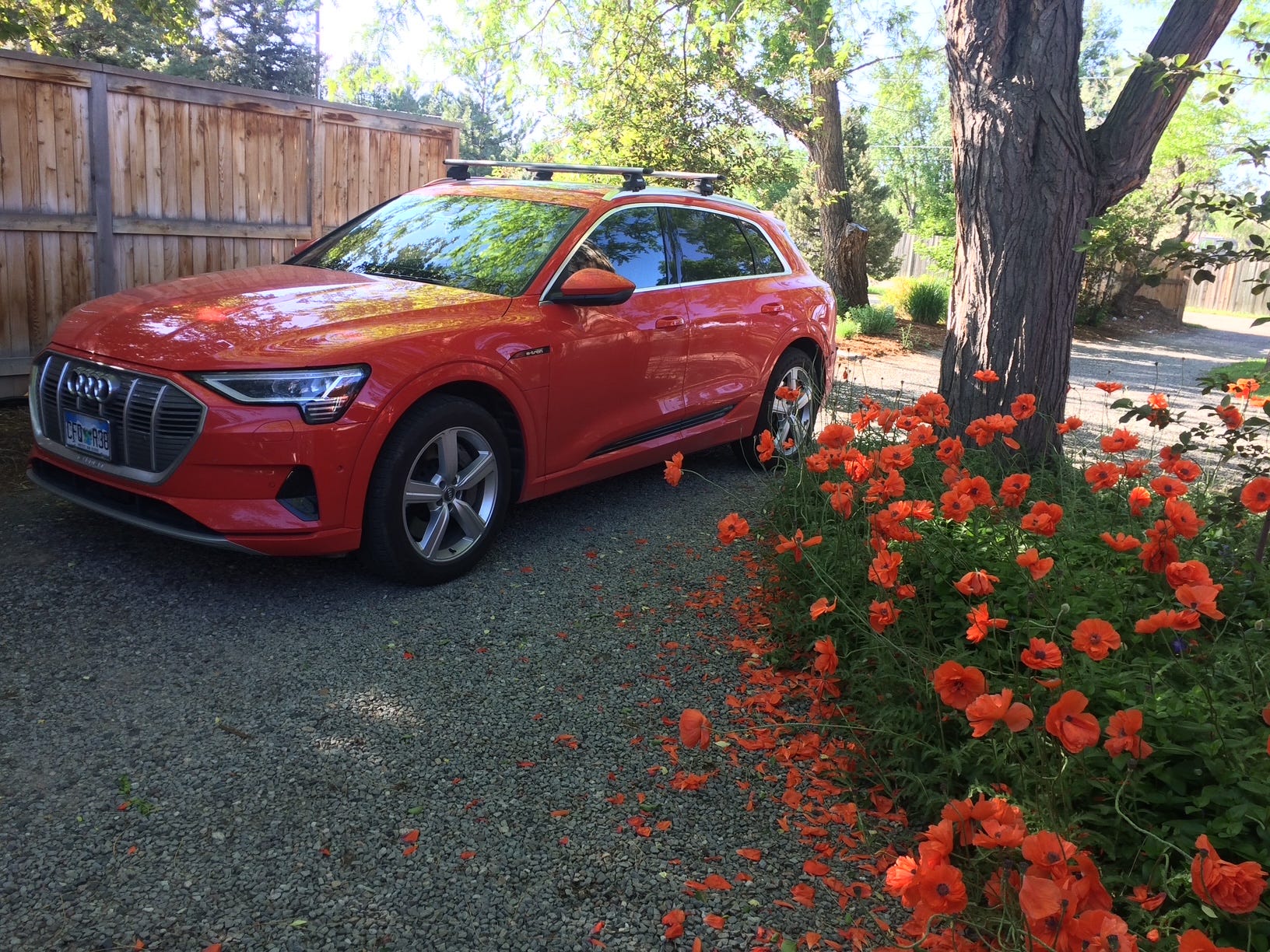
In our driveway. LZ photo
The difference is that the ETron accepts a charge rate of 155kW, while the Bolt EV only accepts 50kW. So to charge from, say, 20% to 80% in the ETron takes 47.5kWh/155kw = 0.31 hours = 18 minutes, while the Bolt takes 33kWh/50kW = 0.66 hours = 40 minutes. Due to the “stadium effect” where it’s harder to find seats and hence slower to fill people into a stadium once it’s 80% full, charge rate drops off quickly after 80% charge with any EV. I generally try to not charge much more than that, but that takes not having “range anxiety”—see number 8 below.
I love our 20-minute average stops to charge every couple of hours; I feel much better at the end of a long drive because I got out and walked around during those stops. But 40 minutes or an hour at each charging stop would get old for me and would discourage me from taking it on long drives.
2. The units
People constantly confuse two critical measures in an EV, namely kilowatts (kW) and kilowatt-hours (kWh).
Avid bike riders know about Watts and often have power meters to measure it. For 200 meters or so, a pro sprinter can put out 1,000 Watts, or one kilowatt (1kW), of power. Belittling as it is for a big muscular sprinter, that’s the same power as 10 illuminated 100-Watt light bulbs.
Power is a measure of energy per unit time. So energy is power multiplied by time.
A bike rider puts out power to propel the bike and takes in energy in the form of food to sustain it. Similarly, an EV’s battery carries stored energy to sustain the power the car puts out.
The energy stored in the food a bike rider eats is measured in kilocalories (kcal), which is listed on the label as Calories with a big “C.” One kilocalorie is the amount of heat (energy) needed to raise the temperature of one kg of water by one degree Celsius (°C). And 1kcal = 1.163Wh.
Power output of a gas-powered car is generally measured in horsepower (hp), while the power of an EV is measured in kilowatts (kW); 1hp = 0.746kW. A battery’s stored energy is measured in kilowatt-hours (kWh). Delivering 1,000 Watts (1kW) of power for an hour is 1,000 Watt-hours or 1kWh of energy consumed.
And charging a battery for an hour at a 50kW charge rate deposits 50kWh of stored energy in the battery.
3. Types of chargers
Car chargers are either alternating current (AC) or direct current (DC). I have found an extreme level of misunderstanding about these even among EV drivers. One acquaintance with a Tesla told me that he would never use a ChargePoint charger because he once plugged into one and it took five hours to charge his car versus 20 minutes at a Tesla Supercharger. This shows no understanding of the difference between a Level 2 and a Level 3 charger, both of which are available on the ChargePoint network.
A Level 1 car charger is literally plugging a car into a normal 110V AC household outlet. It will deliver 1.2 to 1.4kW of power. For my car’s 95kWh battery, it would take 95kWh/1.2kW = 79 hours for a Level 1 charger to charge it fully from zero.
A Level 2 car charger runs at 220V AC and is like plugging the car into a dryer plug. Home Level 2 chargers generally put out around 7kW charge rate, but some commercial Level 2 chargers along the road can run as high as 22kW.
A Level 3 car charger, more often called a DC fast charger, runs at 440V DC. They have consequently much fatter, stiffer wires than Level 2 chargers, which are fatter than Level 1 wires. These are the only types of chargers that make sense to use on a long drive. Some DC fast chargers run up to 350kW charge rates, even though only a couple of cars (Lucid, for one) can accept that high of a charge rate.
4. How to find EV chargers when on the road
I read a NY Times article a few years ago by a guy who had rented a Volvo EV at an airport and used the car’s dashboard screen to find chargers and came up empty, eventually resorting to having the car towed. I know it is stupid to use the in-car system in my Audi, because it only finds a small percentage of the available ones, and I would bet it’s similar in that Volvo.
I have also found that the apps from various charger companies don’t even find all their own chargers, much less those of their competitors.
Instead, I have found that the best method is simply to use Google Maps and search for “DC fast chargers near me”. It not only seems to find them all, but it also tells you the charge rates of the chargers available at the charging station. Unlike the apps, though, Google doesn’t usually tell you how many chargers are occupied at a station.
5. Paying for charging
This is almost always done in the app for the particular charger. There are some chargers that accept a credit card, but that’s rare. A smart phone is a must to drive an EV beyond your local area.
6. EV maintenance costs
There’s not much to go wrong on an EV motor compared to an internal combustion engine. Lots fewer moving parts, no spark, no moving pistons and valves, etc. And due to regenerative braking (the car uses the motor to slow the car and takes the energy returned in the process to charge the battery), the brake pads only touch the rotors when you really stomp on the brakes; most braking produces no brake wear. In the four years we had our first electric car, a Fiat 500e, we spent zero on maintenance other than replacing tires. There’s no oil changes, tune-ups, etc., and nearly no brake wear.
In 100,000 miles on our Audi ETron vs. 115,000 miles on our Audi Allroad, there is no comparison in maintenance expense. (I have long been an Audi devotee, thanks to their incredible performance in the snow—I skied over 100 days/year for many years when I was XC ski racing—as well as their handling and crash-preventative electronic sensors and traction control.) At 100K with the Allroad, it was time to pay $5K for a new timing chain to avoid it breaking and turning the entire car immediately into junk. That’s not to mention replaced water pumps, rotors, brake pads, and dozens of oil changes.
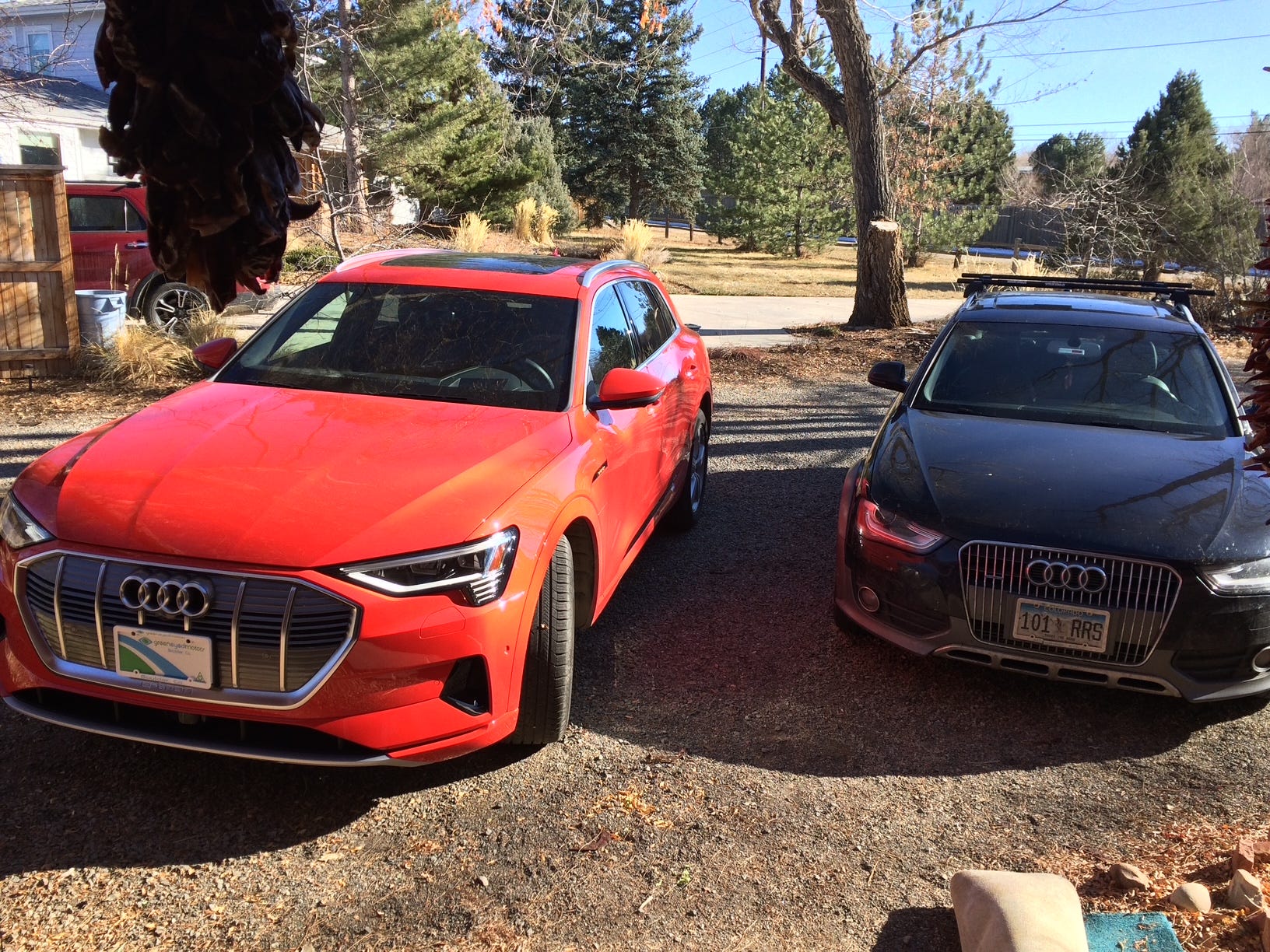
In our driveway. LZ photo
With the ETron, there have been no similar expenses. Despite that it weighs almost 6,000 pounds and accelerates mind-bogglingly fast, every time I bring the ETron in for its every 10,000 mile checkup, the report comes back that the brake rotors and pads have lots of life left in them. I have never gone 100K miles on the original brakes on a gas car.
7. EV vs. plug-in hybrid
A plug-in hybrid offers some of the benefits of both an EV and a gas car. Local driving can be gas-free if you stay within the electric range of the car. And the regenerative braking can also save on brake maintenance like an EV. When on a long drive, though, you can drive further and fill up faster. You would have to stop less often and for less time.
However, if you want to drive a plug-in hybrid on a long drive using only electricity, you can’t, because they will not accept Level 3 (DC fast) chargers. You would have to stop at Level 2 chargers, the type found in parking lots, and those take far too long to be feasible on a long drive. For me the EV is still the way to go unless I’m driving north on state highways through states like Montana and Wyoming where you won’t find DC fast chargers like on interstates.
8. Range anxiety
It’s easy to get worried about not having enough charge, not being able to find a charger, and running out of electrons on the road. I know plenty of people who have fancy, expensive EVs with lots of range and high charge rates who will not consider taking them on the highway out of this fear.
It was good for me to get used to the little 85-mile range of the Fiat 500e. In nearly 10 years of driving EVs, I have never been stranded, despite around half of the 100K miles on our ETron being on highway driving. The car warns you very effectively, once you get used to the wide variation in range shown on the screen depending on if you’re driving uphill or downhill or fast or slowly. Between that information and the ability to find chargers on Google maps, I have confidence enough to take long drives across the country. You do have to plan your route ahead of time based on where the chargers are, though.
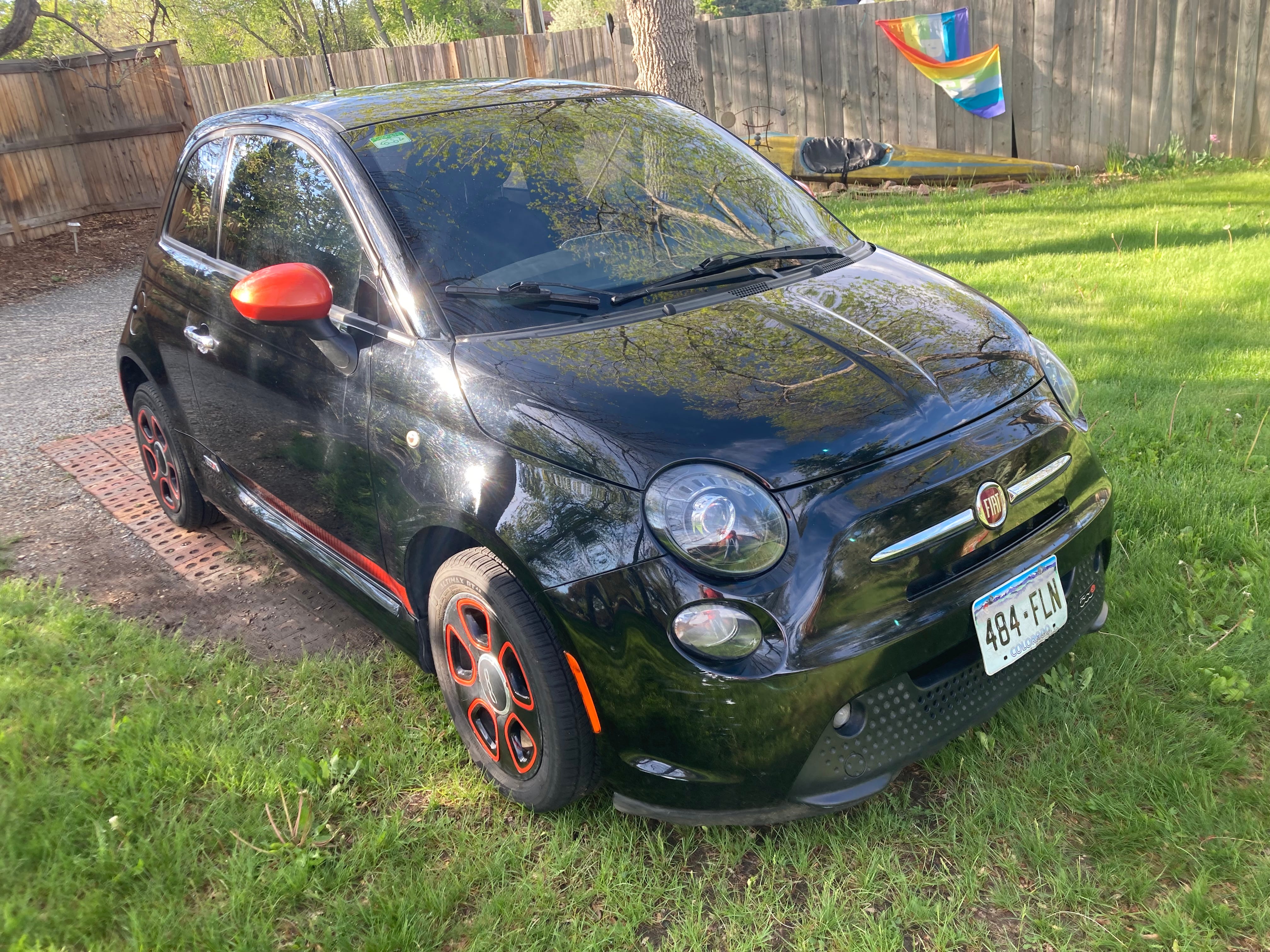
In our driveway. LZ photo
We have driven our ETron to Santa Fe umpteen times to visit my parents, and now that they are both gone, we still go to visit friends and go to the opera. It takes us an hour less time to get there in our gas-powered Audi, which will get there on a single tank of gas, but I feel so much better after arriving there in our electric Audi, because I got out and walked around three times for about 20 minutes each time (its seat massagers and adaptive cruise with lane centering also help reduce the fatigue on a long drive).
And while it takes more time to drive long distances, you save time on short distances, because you never stop to fill up at gas stations; you just plug in at home, and you never take it in for an oil change.
― Lennard
Subscribers can send brief technical questions to Lennard at: veloqna@comcast.net.
As a frame builder, Lennard Zinn has been designing and building custom bicycles for over 42 years; he founded Zinn Cycles in 1982 and co-founded Clydesdale Bicycles in 2017. His Tech Q&A column on Substack follows his 35-year stint as a technical writer for VeloNews (from 1987 through 2022). He is a former U.S. National Cycling Team member and author of many bicycle books including Zinn and the Art of Mountain Bike Maintenance, Zinn and the Art of Road Bike Maintenance, and The Haywire Heart. He holds a bachelor’s degree in physics from Colorado College.
Follow Lennard Zinn on Substack, Strava, X, Instagram, LinkedIn, or Facebook.
Thanks for your insights. We replaced our last ICE car after an accident totaled it with a Tesla. At the time that was what was available and had an available network that could be found.
The car navigates charger to charger. It turns out if a person has children or is of a certain age, they navigate toilet to toilet.
Much like cycling.
We will hit four years this next January. There is a big expensive maintenance routine due at that point.
I’m fine with that. EV’s still require coolant, oil and eventually brake and suspension components. All I’ve done so far is replace fresh air cabin filters. A simple enough task. Not as bad as the old Murano was.
Oddly both cars weighed about the same. With the Nissan being about 200 pounds lighter.
Travel costs with our Model Y have run about a third or slightly less than the Murano. The Model Y has more cargo space but sits more like a car and less like an SUV. The seats are not as low to the floor as a sedan. That seating position is why I chose the Y over the S.
I really did not like the yoke on the X nor the rear doors.
I like the looks of the VW ID Buzz and having grown up in Volkswagens, there would definitely been a pull to that if it had been an available choice when we had the make the decision.
We mostly charge at home overnight off an old unused dryer outlet. 30 amp. The later outlets are 50 amp and if we weren’t renting a too old place I’d install a 50 amp charger. Our electric billing is switched to what the power company calls EV which means at peak times during the day the rate is very high. $.66/kwhr, but the charge schedule uses Super Off Peak at an average of $.12/kwhr. In the last twelve months we have spent $832 on charging including superchargers. Thats over an average of 9,100 miles per year or around $.09/mile to operate less insurance.
In the winter to visit my snowbird parents we drive to Arizona and back from the coast of SoCal. The first stop is an outlet mall where there are super chargers. The walk from the chargers to the restrooms and back takes longer than adding enough charge to get to our next charger/toilet stop. We typically drive about two hours between stops.
Given how busy gas stations were along the same routes to Arizona and Colorado the supercharger is as fast as filling a tank or faster thanks to never waiting in a queue for the charger.
When I was deciding on an EV I came across The Iowa Tesla Guy on YouTube. I learned a lot since he was driving the roads I grew up traveling. From Iowa to Boulder, Colorado and around.
https://youtube.com/@iowatesla?si=XZRLCPeie_2sbr9w
Thanks for taking the time to clear up some misconceptions about EVs, Lennard.
I've driven 30,000 miles in my EV all around the UK, and I've never "waited" for it to charge. By the time I've gone to the toilet, checked my phone, and maybe grabbed a drink, it's charged and waiting for me to continue my trip. And 90% of the time, when I'm doing sub-250-mile days, it charges while I sleep.
If I filled up a petrol car every 300 miles on average, I would have had to fill it up 100 times by now. If it takes ten minutes out of my journey each time, that's 17 hours of dead time. I've also had no mechanical issues, servicing or maintenance to do, other than hitting a huge pothole and having the steering adjusted.
The best part is not having to give money to fossil fuel companies every week or two.