

Cornering Traction, Descending Speed, TPU Tubes
Searching for a reliable TPU inner tube; subtleties of keeping wheels on the ground.

Dear Lennard,
Maybe I missed it but what brand of TPU tube have you had good luck with? I had an experience similar to yours with a glued-in Presta stem (my hand pump took the stem off with it) and another unexplained leakage of a spare … I’m 0 for 2 using TPU tubes as spares.
Steve
Dear Steve,
I would not say that I have yet had good luck with any thermoplastic urethane (TPU) tube. I have only used Tubolito and Eclipse TPU tubes. The former had the glued-in valve core issue we were discussing, and the latter’s sudden failure triggered this post.
Three different people reported varying positive experiences with TPU tubes in this post, only one of which mentioned which brand (RideNow).
And one of those three, also named Steve, has had lots of (and mixed) TPU experience. He reports here how he had had 10K miles without an issue on five different RideNow TPU tubes and then had four of them fail in a row, one catastrophically.
So, if anybody out there has had stellar experience with them and a recommendation of a TPU tube to use, I and others would love to know.
― Lennard
Here is some wonderful feedback I’ve received regarding relative descending speeds of riders of differing weight and cornering forces:
Dear Lennard,
CdA is the projected frontal area, not the surface area.
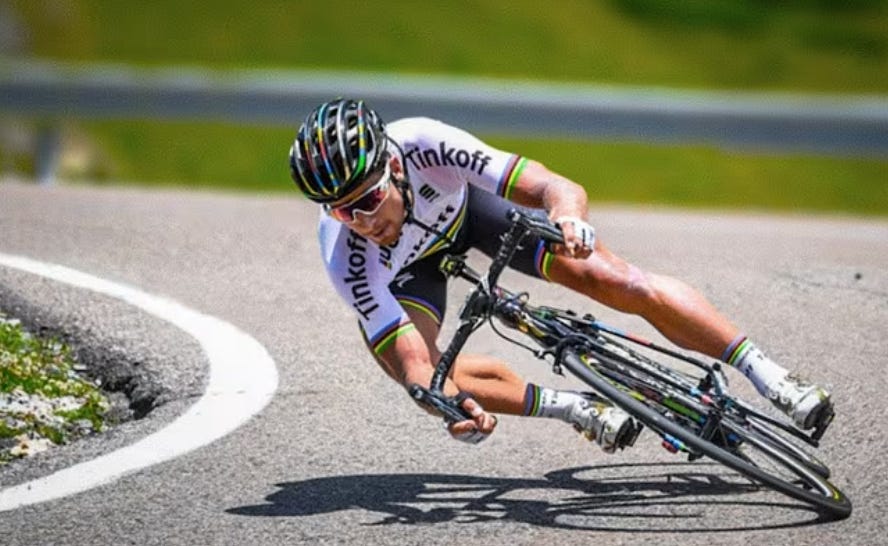
The feeling of cornering safety increases with weight on the outside pedal and inside hand, which I remember reading the CRC of A "magazine" as a teenage racer in the early 70s. I think the article was written by an old timer named something like "Pop" Kruger. He claimed, "it lowered your center of gravity". Even as a teen I knew that wasn't possible, but it was nonetheless sound advice.
Adding the spring in your leg certainly does help keep the tires in contact.
But I think there is more to the improved feeling of cornering security than can be attributed to the reduction in unsprung weight.
I don't have a theory, but over the decades I've advised many riders to distribute more weight to the outside leg and inside hand, and they always agree that it feels better and encourages them to go faster.
In college I had a streamlined bike project (the human powered vehicle competition) which suffered from aeroelastic coupling which produced a terrifying resonance between the rigidity of the shell attachment (a laminar NACA airfoil) and the steering / balance dynamics of the conventional bike inside. One of the team members did a serious mathematical study of the coupling and proposed a variety of damping strategies. He had a stack of Calspan papers on bike handling written by PhDs under grants.
I might even have a copy of his final Senior Project report in the basement. I'm pretty sure I have my summary report.
That was at Cornell in the late 70s, and the main thing I remember is that there was a tremendous amount of math, but no solid theoretical model. I'm suspicious that the weighting tactic we're discussing is likewise difficult to explain mathematically, but it can be felt.
Randy
Dear Lennard,
Good comments and followup, thanks. Here's a couple of more points:
To demonstrate how much faster heavier riders descend, ride side-by-side, at least a few feet (~1 meter) apart (for aerodynamic separation). I used to use a favorite hill out in the country, with few cars. This way you will both be subject to the same winds and the same grade. Carefully match speeds and then start coasting. Repeat, but with one rider in a different positions (or different tire pressures, etc.) to get a feel for the effect of the change. Bonus is lots of hill climbing to make the next test run!
I like the unsprung weight explanation for standing on the outside pedal, the knee and ankle make a very good “intelligent” suspension. However, since I'm almost always riding an Alex Moulton with suspension, standing on a pedal and unweighting the seat doesn't do much for me. Road suspension gives another advantage, if you pedal through a corner and lightly ground the inside pedal, you don't lift a tire right off the ground (and crash), instead, the suspension extends a little bit and you have a chance of holding your line. When they are allowed (rarely), Moultons usually clean up in crits on rough roads.
Doug
Dear Lennard,
That was an interesting post about cornering forces. I saw a good mountain bike instructional video a few years ago that did a great job of explaining why using the outside pedal feels so much more effective. When applying the force to the outside pedal - centrifugal forces aside, my body weight, through the pedals, is being applied almost vertically relative to the two contact patches. So why is this important?
I believe that being both in line with the contact patches, as well as being very close to the ground, offers much more pressure control and lateral mobility (being able to easily move the bike under me), as I'm steering through the turn. As with skiing, weighting the outside ski, or pedal in the case of cycling, allows me to more effectively pressure the carving ski or pedal, because the knee is designed to articulate inward, and not outward. This “comma” position, to borrow a phrase from skiing, allows quick, subtle adjustments to the ski edge or tire contact patches relative to my center of mass, as edging/traction is gained or lost, whereas if I lose rear wheel traction while sitting on the seat, or with my weight on the inside pedal (or ski), I'm likely to hit the deck before I can react.
Steve
Thanks all of you for your wonderful contributions to this column. You have educated all of us. I love learning from you.
― Lennard
Subscribers can send brief technical questions to Lennard at: veloqna@comcast.net.
As a frame builder, Lennard Zinn has been designing and building custom bicycles for over 42 years; he founded Zinn Cycles in 1982 and co-founded Clydesdale Bicycles in 2017. His Tech Q&A column on Substack follows his 35-year stint as a technical writer for VeloNews (from 1987 through 2022). He is a former U.S. National Cycling Team member and author of many bicycle books including Zinn and the Art of Mountain Bike Maintenance, Zinn and the Art of Road Bike Maintenance, and The Haywire Heart. He holds a bachelor’s degree in physics from Colorado College.
Follow Lennard Zinn on Substack, Strava, X, Instagram, LinkedIn, or Facebook.
Cornering. When I returned to cycling in 1994 after a 12-year hiatus, much had changed. I bought several books to catch up on "modern" and one, Davis Phinney's "Training for Cycling: The Ultimate Guide to Improved Performance" suggested weighting the outside leg hard as opposed to extending the inner knee towards the ground. I found this worked well with my then-newly acquired STI-equipped Faggin. We have a lot of hills here on California's Northcoast and the Faggin seemed to love going downhill. Alas, Phinney's book was a victim of downsizing a few years ago and cornering is the only thing I remember from it.